
Ask what a marketing stack costs and you get a useless answer, because the tools are not priced on the same thing. One charges per seat, the next per contact, the third a flat fee, and a fourth by how many times your automations fire. Comparing headline prices across those models is like comparing a rent, a mortgage, and a hotel rate.
So we priced twelve tools at three team sizes — one person, five people, and twenty — and wrote down the assumptions. The interesting result is not which tool is cheapest. It is that the ranking completely reorders between one seat and twenty, and that several tools cannot serve a twenty-person team at all on their published plans.
At one seat, per-seat tools are almost free and flat-rate platforms look expensive. By twenty seats that is exactly inverted: per-seat pricing produces four-figure monthly bills while flat pricing has not moved. Two of the twelve have no published plan that supports twenty users. If you are choosing a platform you expect to grow into, the billing axis matters more than the headline price.
Every figure below is in an interactive calculator: enter your team size and list size and it prices all thirteen tools against them. Open the stack cost calculator.
Methodology
Stated up front so you can check the work or redo it with your own numbers.
- Annual billing where the vendor offers it, expressed as a monthly equivalent. Monthly billing is typically 15–33% higher.
- US pricing, in USD, checked against each vendor's public pricing page in August 2026.
- Contact-priced tools are shown at their published contact tiers. Where a vendor uses an interactive slider and publishes no static figure at a given tier, the table says so instead of estimating.
- Add-ons are excluded unless the vendor requires them. This flatters tools with large add-on catalogues — noted where it matters.
- Required one-time fees are included in the notes but not in the monthly figure, since they do not recur.
- Scalry is priced at its most expensive published plan in every scenario, so this study never flatters the platform publishing it.
The three billing models
Before any numbers, here is what each tool actually meters. This is the single most useful table in the study, because it predicts what happens to your bill as you grow.
| Tool | Bills on | Published entry price |
|---|---|---|
| Scalry | Flat per workspace | $29/mo |
| GoHighLevel | Flat per agency account | $97/mo |
| Systeme.io | Contacts | $0 (free tier), then $17/mo |
| Mailchimp | Contacts | $13/mo at 500 contacts |
| ActiveCampaign | Contacts | $15/mo at 1,000 contacts |
| Kartra | Contacts | $52/mo at 500 contacts |
| ClickFunnels | Contacts, with seat caps | $81/mo at 10,000 contacts |
| Calendly | Seats | $10/seat/mo |
| Pipedrive | Seats | $14/seat/mo |
| Zoho CRM Plus | Seats | $57/user/mo |
| HubSpot Marketing | Seats + marketing contacts | $7/seat/mo (Starter) |
| Keap | Users + contacts | $249/mo (2 users included) |
| Zapier | Automation tasks | $19.99/mo at 750 tasks |
Note the last row. Zapier is the only tool here billed on something that scales with your traffic rather than your team or your list, which is why integration bills surprise people: the invoice grows when a campaign works.
Scenario one: a solo operator
One person, one brand. Per-seat pricing is at its most favourable here, and it shows.
| Tool | Plan | Monthly | Notes |
|---|---|---|---|
| Calendly | Standard | $10 | Free tier also viable |
| Mailchimp | Essentials | $13 | 500 contacts |
| Pipedrive | Lite | $14 | Cheapest real CRM here |
| ActiveCampaign | Starter | $15 | 1,000 contacts |
| Systeme.io | Startup | $17 | 5,000 contacts; free tier covers 2,000 |
| Zapier | Professional | $19.99 | 750 tasks |
| Scalry | Starter | $29 | Flat |
| Kartra | Essentials | $52 | 500 contacts, 5 pages, 1 product |
| Zoho CRM Plus | — | $57 | Per user |
| ClickFunnels | Launch | $81 | 10,000 contacts, 2 seats |
| GoHighLevel | Starter | $97 | Unlimited contacts and users |
| Keap | Base | $249 | 2 users; implementation fee extra |
| HubSpot Marketing | Starter | $7 | 1,000 marketing contacts |
HubSpot Starter at $7 is the cheapest line in the entire study, and genuinely good value for one person with a small list. Keep it in mind for the twenty-seat table, where the same product behaves very differently.
Scenario two: a five-person team
Same tools, five people. Per-seat costs multiply; flat and contact-based pricing does not move.
| Tool | Plan | Monthly | Change vs 1 seat |
|---|---|---|---|
| Systeme.io | Startup | $17 | No change |
| Scalry | Agency | $199 | No change (top plan) |
| GoHighLevel | Starter | $97 | No change — unlimited users |
| Calendly | Standard × 5 | $50 | ×5 |
| Pipedrive | Growth × 5 | $195 | ×5 |
| Zoho CRM Plus | × 5 users | $285 | ×5 |
| Zapier | Team | $69 | Shared seats begin here |
| Kartra | Starter | $99 | Tier up: 5 team members |
| ClickFunnels | Scale | $164 | Tier up: Launch caps at 2 seats |
| Keap | Base + 3 users | $366 | +$39/user over the 2 included |
| HubSpot Marketing | Professional + 2 seats | $890 | Starter is too limited; Pro includes 3 seats |
| Mailchimp | Standard | $135 at 10,000 contacts | Contact-driven, not seat-driven |
| ActiveCampaign | Contact-tier dependent | See note | Slider pricing |
Two things happen at five seats. First, ClickFunnels and Kartra force a tier upgrade not because of list size but because of headcount — their seat caps are the binding constraint. Second, HubSpot jumps from $7 to $890, because Starter's automation ceiling pushes teams to Professional, which also carries a required $3,000 one-time onboarding fee.
Want to see what your own numbers look like? Start a workspace and price it against the table above.
Start free14-day free trial · No credit card required
Scenario three: a twenty-person team
This is where the models diverge hardest — and where two tools drop out entirely.
| Tool | Plan | Monthly | Notes |
|---|---|---|---|
| Systeme.io | Unlimited | $97 | Unlimited contacts |
| GoHighLevel | Starter | $97 | Still unlimited users |
| Scalry | Agency | $199 | Still flat |
| Calendly | Standard × 20 | $200 | |
| Zapier | Team | $69+ | Rises with task volume, not seats |
| Pipedrive | Growth × 20 | $780 | $1,180 on Premium |
| Zoho CRM Plus | × 20 users | $1,140 | |
| Keap | Base + 18 users | $1,001 | |
| HubSpot Marketing | Professional + 17 seats | $1,565 | Enterprise is $3,600 + $75/seat |
| ClickFunnels | Dominate | $500 | Annual only at $5,997/yr; Optimize caps at 10 seats |
| Kartra | — | Not supported | Published plans cap at 10 team members |
| Mailchimp | Standard/Premium | Contact-driven | Seat limits vary by tier |
| ActiveCampaign | Contact-tier dependent | See note | Slider pricing |
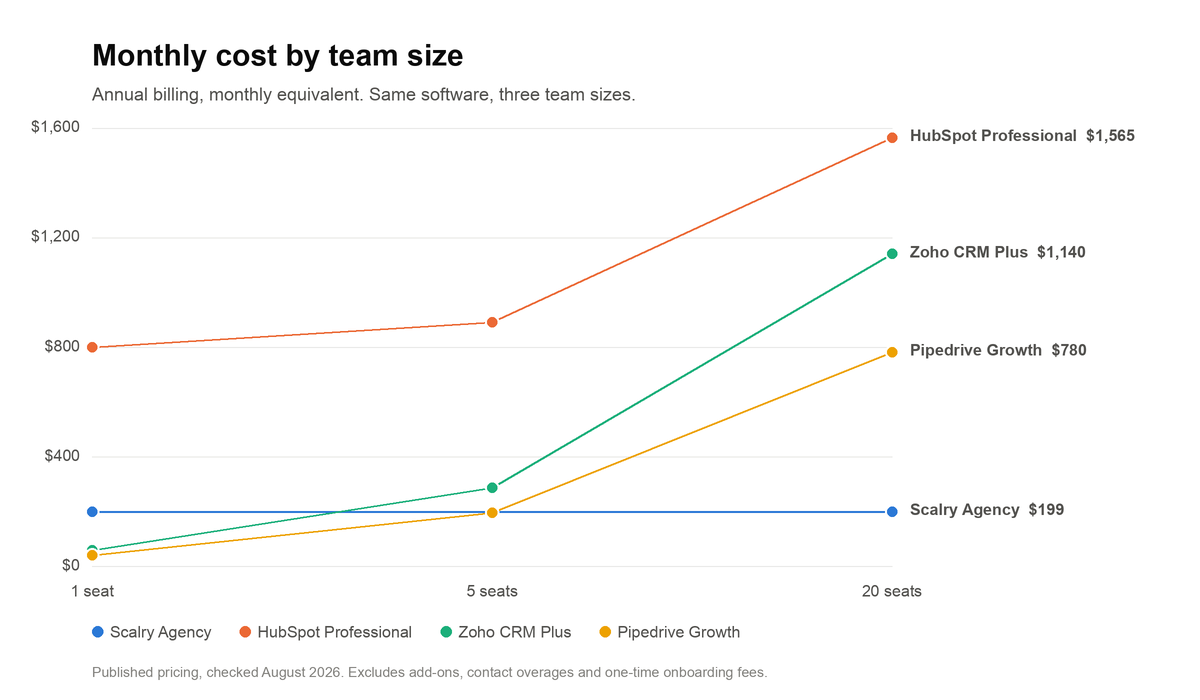
Between one seat and twenty, GoHighLevel's bill does not move at all and Scalry's does not either. Zoho goes from $57 to $1,140 — a twentyfold increase for the same software. HubSpot goes from $7 to $1,565, a 224× increase. Kartra cannot serve the team at any published price. None of that is visible on a pricing page.
The crossover points
If you only remember one thing, make it this: there is a team size at which each pricing model stops being the cheapest, and it is smaller than most people expect.
- Pipedrive vs Scalry: Pipedrive Growth is cheaper up to about five seats ($195 vs $199), and more expensive after. The crossover is five people.
- Zoho CRM Plus vs Scalry: crossover at roughly four users ($228 vs $199).
- HubSpot Starter vs anything: unbeatable until you need real automation, at which point the next step is $800/month. There is no middle rung.
- Contact-priced tools: the crossover is driven by list growth, not hiring — but seat caps can force an upgrade first, which is the trap.
- Flat-priced tools: most expensive at one seat, cheapest at twenty. They are a bet on your own growth.
The seat caps nobody reads
The least visible cost in this study is not a price at all. It is a ceiling.
ClickFunnels Launch allows two team members. Kartra Starter allows five, and its most expensive published plan allows ten. HubSpot Professional includes three core seats. These caps mean that hiring — not list growth, not usage — is what forces the upgrade, and they are typically listed in a feature table rather than beside the price.
For a growing team this inverts the usual advice. You are not choosing the cheapest tool for your current size; you are choosing the tool whose next tier you can live with.
What this study does not capture
Being explicit about the gaps, because a cost table that pretends to more precision than it has is worse than no table.
- Slider pricing. ActiveCampaign and Mailchimp price through interactive contact selectors and publish no static figure at most tiers. Where we could not verify a number from the vendor, we said so rather than quoting a third-party estimate as fact.
- Add-ons. Pipedrive's LeadBooster, Campaigns, Projects and Smart Docs are each extra; so is HubSpot's contact overage. Every seat-priced tool here looks better than a real configuration would.
- One-time fees. HubSpot Professional carries a required $3,000 onboarding fee and Enterprise $7,000. Keap requires implementation, quoted per customer and not published.
- Usage costs. SMS, calling, and AI generation are metered on most of these platforms. GoHighLevel's messaging runs through your own Twilio account.
- Feature parity. These tools do not do the same things. A cheap tool that does not solve your problem is not cheap.
How to price your own stack in twenty minutes
- Write down your headcount in twelve months, not today. Multiply every per-seat line by that number.
- Write down your list size in twelve months. Multiply every contact-priced line by the tier that covers it.
- Check the seat cap on every plan you shortlisted. This is the step almost everyone skips.
- Add the required one-time fees to year one, then divide by twelve to compare monthly.
- Add the tools that fill the gaps — a scheduler, a page builder, creative tools, and the integration glue holding them together.
- Compare the totals, not the headline prices. That is the entire point of this exercise.
Questions to ask before you commit
Whichever way you are leaning, these are the questions that change the answer. Work through them against your own numbers rather than anyone's feature matrix — including this one.
- Which axis does this bill on? Seats, contacts, usage, or flat. Everything else follows from it.
- What is the seat cap on the plan I am pricing? Not the price of the next tier — the ceiling on this one.
- What does the next tier up cost? You will probably be on it within a year.
- Which add-ons are actually required for the workflow I have in mind?
- Is there a one-time fee? Onboarding and implementation are real year-one costs.
- What am I paying separately today that this would absorb — or that it would not?
If you cannot answer the first three, you are not ready to choose between Scalry and any platform yet — you are still deciding what you need, which is a cheaper problem to solve first.
Frequently asked questions
What is the cheapest marketing platform for a solo operator?
On published pricing, HubSpot Marketing Starter at $7/seat/month is the cheapest line in this study, followed by Calendly at $10, Mailchimp Essentials at $13, and Pipedrive Lite at $14. Systeme.io's free tier costs nothing at all and covers 2,000 contacts. The catch is that the cheapest entry tier often has the steepest next step.
Which pricing model is best for a growing team?
Flat per-workspace pricing, if you expect to grow. Between one and twenty seats, flat-priced tools in this study did not change price at all, while per-seat tools rose by up to 224 times. Below about four or five seats, per-seat pricing is cheaper.
Why did HubSpot go from $7 to $1,565?
Two compounding reasons. Starter's automation limits push most teams to Professional at $800/month, and Professional includes only three core seats, with each additional seat at $45/month. Seventeen extra seats adds $765. A required $3,000 one-time onboarding fee sits on top of the first year.
Which tools cannot support a twenty-person team?
Kartra's published plans cap at ten team members. ClickFunnels requires its annual-only Dominate plan at $5,997/year to reach twenty. Several other tools support the headcount but at a price most teams that size would not expect.
How often does this pricing change?
Often enough that you should verify before committing. These figures were checked in August 2026 against each vendor's public pricing page. Treat the billing models as durable and the specific numbers as perishable.
Scalry is flat-priced, so the twenty-seat column is the same as the one-seat column. You can rebuild one real campaign inside Scalry before moving anything else.
Start your free trialSee pricing14-day free trial · No credit card required
